Tell one agent to start another
You are with Claude on the checkout, and a second problem needs Codex: you stop, open a card, pick the model and write the brief. In Offsite you tell Claude, and it opens a Codex card beside its own with the model you named and writes the brief, as a fresh session or as a fork of your conversation. By voice from the phone, too.
You are with Claude Code on the checkout, and a flaky cart test keeps failing in between. It is a job for Codex, and you want to stay on the checkout. So you stop, open a new card, pick Codex and its model, and write the brief: which test, what fails, where to look. Then you find your way back into the checkout.
In Offsite you tell Claude instead: “Start a Codex session with Astra and have it fix the flaky cart test, while we focus on the checkout.” Claude opens a new card beside its own with Codex in it, GPT-6-Astra already chosen as its model, and writes Codex its brief. Codex gets to work, and you and Claude carry on with the checkout. You can dictate the sentence on the iPhone as well as type it on the Mac, and each of Claude Code, Codex and Grok can start any of the three.
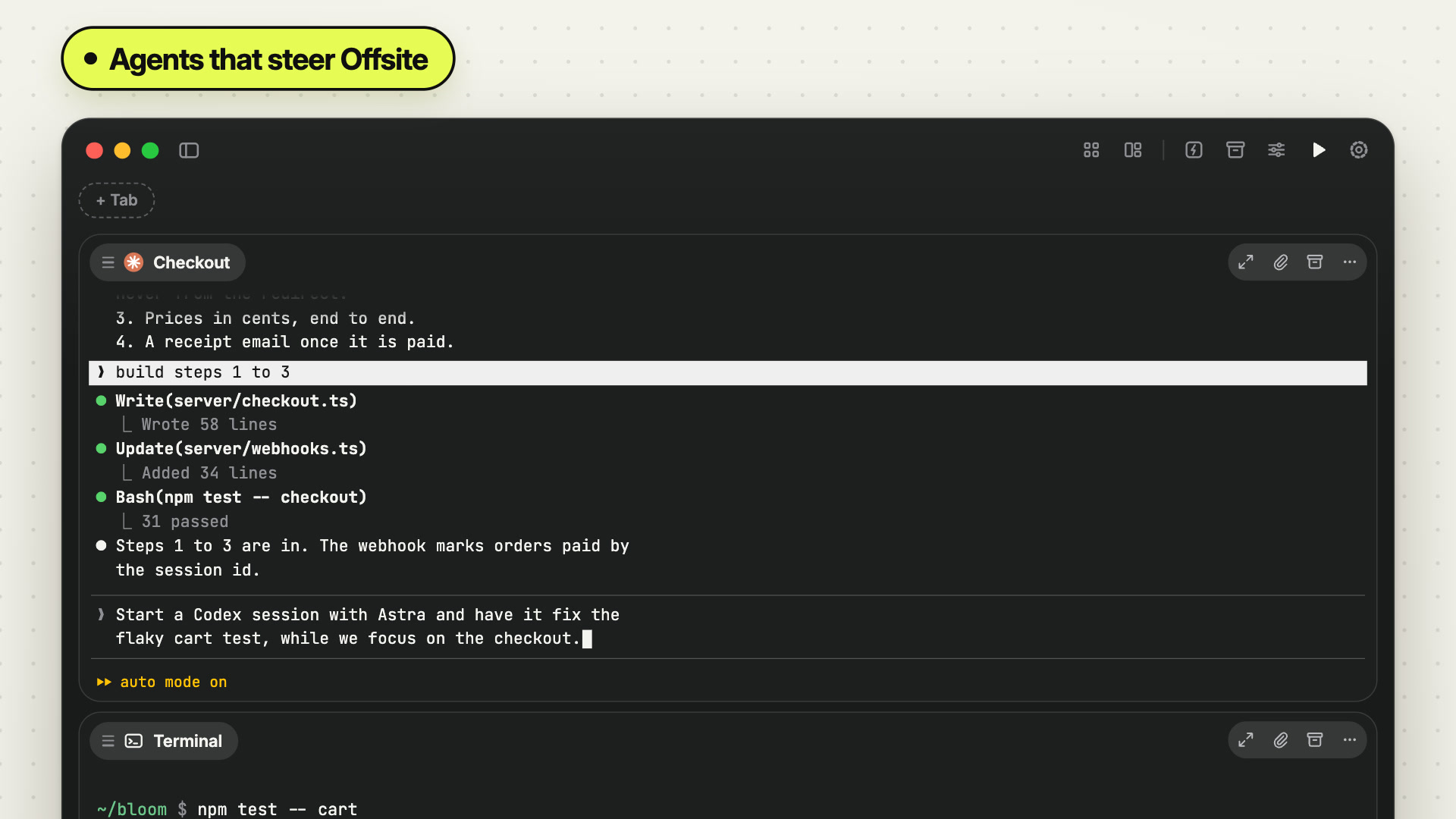 0:43
Fresh, or a fork of this conversation
Fresh, with just the task. The new session knows only the brief it gets, so the agent writes it to stand on its own: what to do, where, and how to tell it is done. That suits a separate job like the flaky test.
A fork of this conversation. “Start a new session from here and build the receipt emails, while we go on with the checkout.” The new session first reads where this one stands, the last 300 entries of its transcript, and then builds. The old session carries on with you. It is the agent’s way to the same result as Hand off to a new session… in the card’s menu.
More you can say
“Fix this bug, commit and push, and close the session.” One job, done alone. The agent fixes the bug, commits and pushes, writes a last recap line and says goodbye. When its turn ends, the card moves to the Archive, where you bring it back with its conversation at any time. The board stays tidy without you clearing it.
“Have Grok write the tests while you keep going.” A job for another agent. Grok starts in a card right of this one with the tests as its task, written out so it stands on its own, and gets to work. The session you are in goes on with you.
“Carry on in a fresh session, and close this one.” For the moment the context is full. The new session reads where this one stands and continues the work, and the old card moves to the Archive.
“Check what Codex found and have Grok fix it.” Across tools. The agent finds the Codex session on the board, reads its transcript from disk and starts Grok with the findings as its task. The Codex session is never typed into or interrupted. “What are the others doing?” works the same way: every running agent with its workspace, whether it is busy or idle, and its latest recap line.
“Start a Claude in bloom-admin for the API client.” Another project. The new card opens on the board of the workspace you name, with the task as its first message.
Whenever it starts a session, the agent tells you which card it started and carries on with its own work. It does not wait for the new session.
How it works
Tools from Offsite’s own MCP server. Every agent session in Offsite has the offsite_computer server in its tool list, and with it session_start, agents_list, agents_context and session_finish. The instructions Offsite gives each agent name the tool for each request, so a plain sentence is enough.
Starting work follows your agent’s permission mode. A new session starts work that runs on your subscription, so it goes through the agent’s own approval, like a command that does real work. In Auto the CLI’s rules decide whether it asks you first; in YOLO it goes ahead. A new session of the same agent takes over the asking session’s mode; another agent starts with its own default. In Claude Code and Codex, reading your other sessions and closing its own card never ask.
Any agent can start any of the three. Name the agent in the sentence, or the new session uses the same one as the session that asks. A model and a reasoning effort can be named too, for example “Codex on high effort”.
The board stays yours. The new card lands right of the card that started it, or at the left edge of another workspace’s board when you name one. It starts under the name the asking agent gave it, or the agent’s own, and renames itself once it knows its work. It is a session like any you open yourself: you type into it, move it, hand it on.
From the phone too. The tools run on your host, so the sentence works wherever you type it. Ask on the iPhone on your way, and the new card is on the board when you sit down at your Mac.
Offsite as the place your agents work
Until now Offsite was how you reached your agents: the same sessions on your Mac and your iPhone, from any network. With these tools your agents work Offsite for you as well. On your word they open sessions in any of the three tools, pass work on, read each other’s results and tidy the board, and the permission mode you chose decides what asks you first.
New posts by email
An email when a new post is out, about Offsite and about working with coding agents.
You confirm your address once, and every email has an unsubscribe link. Sent with Buttondown, see the privacy policy.