This month in agentic coding: October 2026
Claude Opus, Sonnet and Haiku 5.5, GPT-6 Sol and Luna in Codex, Grok 4.7, AGENTS.md in Claude Code and a status protocol for terminals, with sources.
The tools you code with change faster than anyone reads their changelogs. Between 17 September and 15 October, Claude Code published 25 releases on GitHub and the Codex CLI 17. New models arrived from all three labs in the same four weeks.
This digest collects what changed for developers who work with Claude Code, Codex and Grok, from mid-September to mid-October 2026. Every item links to its primary source and says what it means for your day.
Anthropic and Claude Code
Claude Opus 5.5: cheaper, and the default on Pro
22 September. Opus 5.5 costs $4 per million input and $20 per million output tokens, 20% less than Opus 5, and since it also uses fewer tokens per task, Anthropic puts the drop in costs at 40%. Anthropic also raised the five-hour usage limits on Pro, Max, Team and seat-based Enterprise plans and gives subscribers a rate limit reset they can save and use when they choose; fast mode runs up to 2.5 times faster at $8 and $40 per million tokens. Claude Code 2.1.280 made Opus 5.5 the default Opus model with a 1M context window and switched Pro and Team Standard plans from Sonnet to Opus as their default, so new sessions on Pro start on Opus.
Claude Sonnet 5.5
28 September. Sonnet 5.5 keeps the Sonnet 5 price of $2 and $10 per million tokens; Anthropic reports output more than 30% faster and, in its own testing, up to 30% lower cost per task. Its default effort in Claude Code is Medium, and since 2.1.284 it is the default Sonnet model on the Anthropic API. If you call Sonnet through the API with thinking switched off, the announcement asks you to move to the new between_tools setting first.
Claude Haiku 5.5, and API credits for Max and Team
7 October. Haiku 5.5 costs $0.10 per million input and $0.50 per million output tokens for prompts up to 100K tokens, and Anthropic says it “pairs well with Opus 5.5 and Sonnet 5.5 as a subagent on coding work”; Claude Code 2.1.293 made it the default Haiku model on the Anthropic API. The same day, Max and Team plans gained monthly API credits: $100 on Max 5x, $200 on Max 20x and up to $500 pooled on Team, claimed by linking a Claude Console organization (release notes). That is a monthly budget for running your own apps and agents on the Claude Platform.
Claude Code reads AGENTS.md
18 September. Since 2.1.277, Claude Code reads AGENTS.md in a project that has no CLAUDE.md, and Project instructions in /config changes that. Codex reads AGENTS.md too, so a repository where both agents work can keep its build commands and rules in one file.
Idle compaction
14 October. A Claude Code conversation over 200K tokens that sits idle for about 54 minutes is now compacted before its one-hour prompt cache expires, so your next message does not reprocess the whole history (2.1.299). If you prefer the full history, "idleCompaction": false in settings.json turns it off, and CLAUDE_CODE_IDLE_COMPACT_MIN_TOKENS moves the 200K threshold.
OpenAI and Codex
GPT-6 Sol, GPT-6 Luna and GPT-6.1 Sol in Codex
22 and 29 September. GPT-6 Sol, for complex coding and agentic workflows, and GPT-6 Luna, for focused, high-volume tasks, reached Codex “at lower token prices than their GPT-5.6 predecessors”; a week later came GPT-6.1 Sol, which “offers near-Astra performance for complex work at a lower cost than Astra”, with availability that depends on your plan, client and workspace (Codex changelog). The notes of Codex CLI 0.159.1 add GPT-6.1 Sol “as the default model in the bundled catalog”. In the CLI, /model or codex --model gpt-6-luna picks another model.
GPT-5.5 leaves Codex for ChatGPT sign-ins
14 October. At noon PDT, GPT-5.5 retired from Codex for users signed in with ChatGPT; API-key sessions and the API are unaffected (Codex models). If a config, a custom agent, a scheduled task or a script pins gpt-5.5, point it at gpt-6.1-sol, the suggested replacement.
Codex CLI 0.163: steer while it answers
15 October. In 0.163.0, a follow-up you send while Codex is responding steers it immediately, and an interrupt also stops running Code Mode cells. Independent read-only tools now run in parallel, and /config searches all preferences and applies supported changes at once. You correct course in the middle of a turn.
Grok
Grok 4.7
21 September. Grok 4.7 is priced from $2 per million input tokens and $6 per million output tokens, and it was available in Grok Build and Cursor on the first day. A fast variant runs at twice the output speed for twice the price. If you work in Grok Build, it is one model switch away.
Across the tools
A status protocol for terminals: OSC 7501
6 and 8 October. The Program Status Protocol by Mitchell Hashimoto, first drafted on 28 September, is an escape sequence a program uses to tell the terminal whether it is idle, working, waiting on the user, finished or failed, and why. Support landed in libghostty-vt on 6 October (the Ghostty app ignores the reports for now), and Claude Code 2.1.295 has emitted it since 8 October. Terminals that read it can show whether your agent is working, waiting on you or done, without matching screen contents.
From where we sit
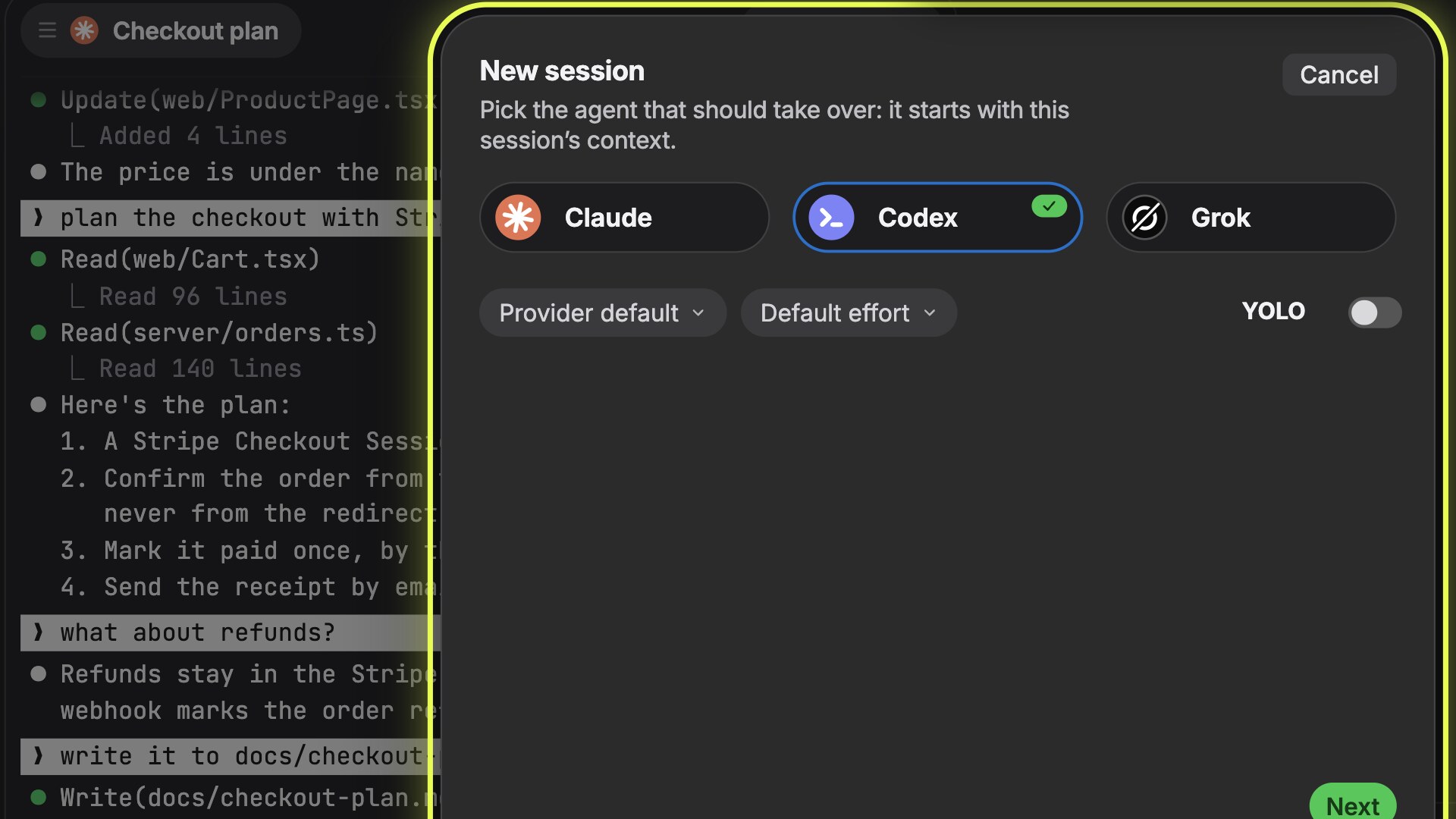
Offsite runs claude, codex and grok side by side on one board, so all three changelogs land on our desk. The models made the headlines. For daily work, the changes in the CLIs themselves matter as much: one instructions file for two agents, steering in the middle of a turn, compaction timed to the cache. OSC 7501 gives any program a standard way to say that it is waiting for you. Offsite’s notifications rest on the same idea and come from the CLIs’ own hooks, which keeps them working through CLI updates.
New posts by email
An email when a new post is out, about Offsite and about working with coding agents.
You confirm your address once, and every email has an unsubscribe link. Sent with Buttondown, see the privacy policy.